Dual-Engine Architecture Deep-Dive
Deep Dive 10 min read Go 1.26 & Rust 1.98.1 Edition 2024
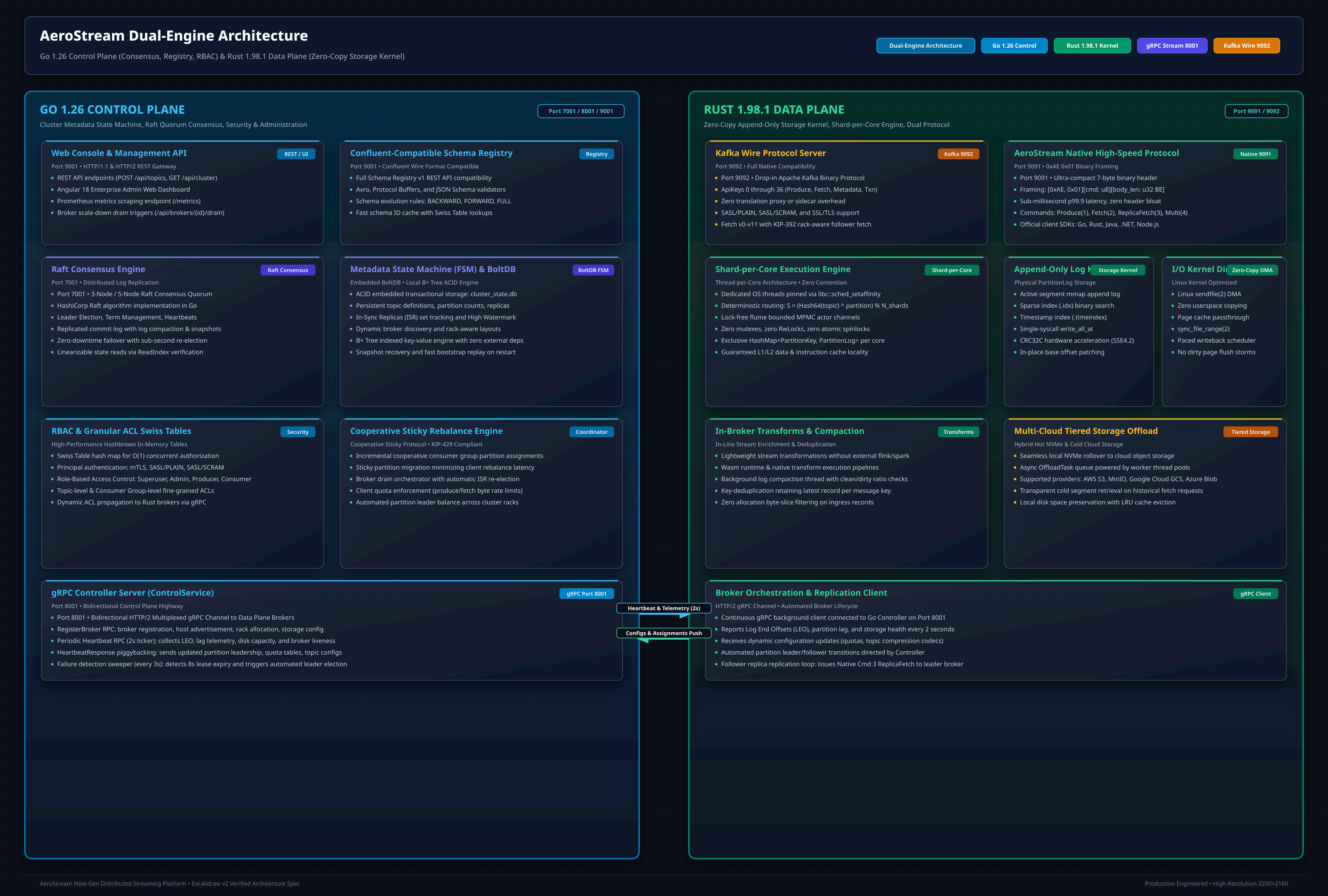
AeroStream's core architectural principle is the strict physical and operational separation of distributed consensus from log storage and network I/O. Rather than running everything inside a monolithic runtime, AeroStream combines two purpose-built engines:
- A Go 1.26 Control Plane handling cluster orchestration, distributed Raft consensus, dynamic metadata coordination, schema governance, enterprise RBAC/ACLs, and REST/Admin APIs.
- A Rust 1.98.1 (Edition 2024) Data Plane running a shard-per-core storage engine, lock-free append-only log segments, zero-copy network sockets, and hardware-accelerated batch verification.
1. Control Plane Architecture (Go 1.26 & Raft Quorum)
The AeroStream Control Plane runs as a lightweight, resilient microservice dedicated to maintaining the cluster's ground truth.
Quorum Elections & Health Heartbeats
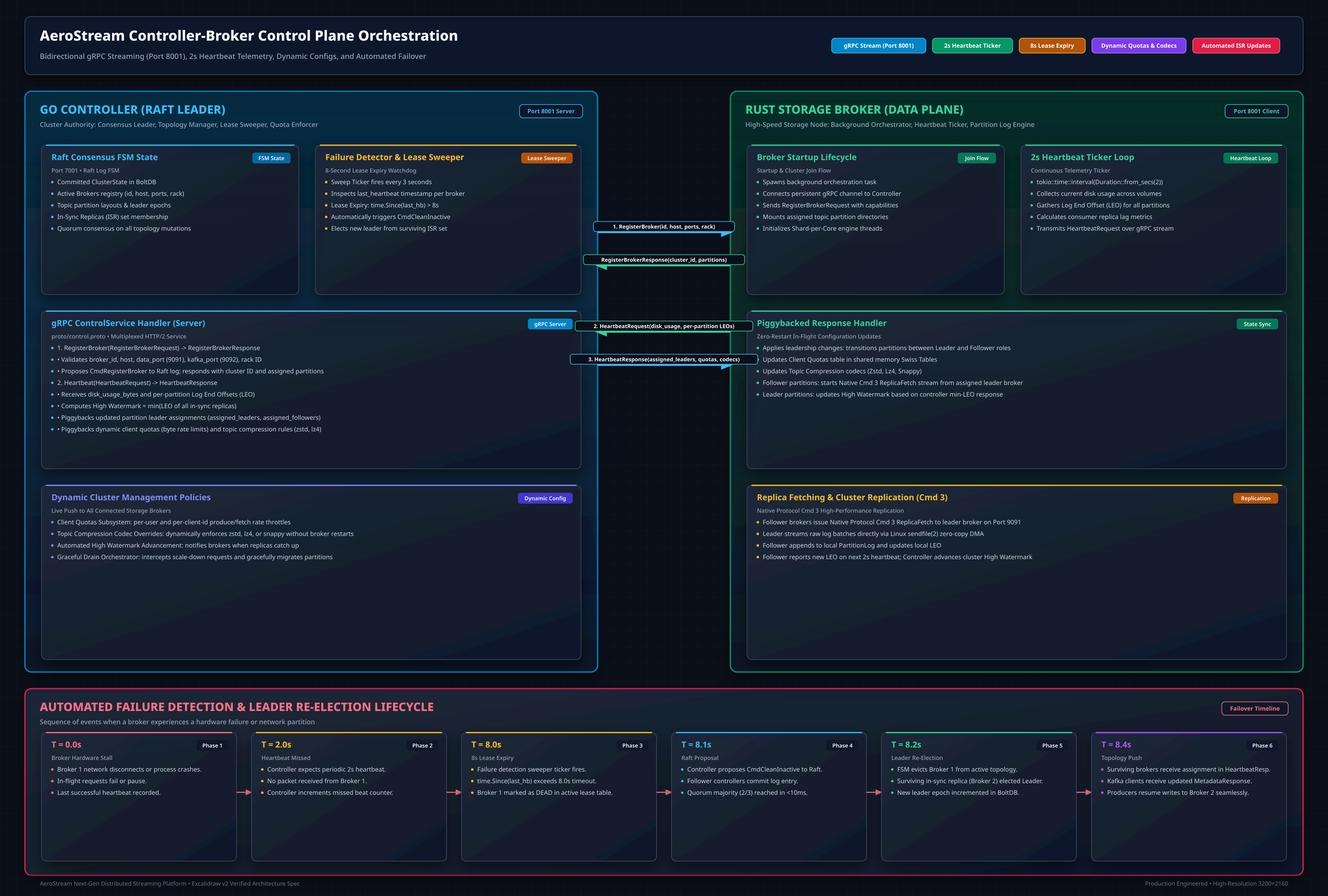
- Sub-150ms Leader Elections: The control plane utilizes HashiCorp Raft. In the event of a leader controller failure, remaining voter nodes detect heartbeat timeout and elect a new leader in under 150 milliseconds.
- Continuous Broker Heartbeats: Storage brokers transmit UDP/gRPC heartbeats every 2 seconds to the active controller on port
8001. If a broker fails to heartbeat within the grace threshold (default 6–8 seconds), the controller marks it unreachable and automatically promotes in-sync replicas (ISR) to partition leaders. - Piggybacked Dynamic Configuration: Controller responses to broker heartbeats piggyback partition assignment deltas, dynamically updating broker routing, client quotas, and compression policies without restart.
Partition Consensus & High Watermark (\(HW\)) Tracking
Replication safety across multi-node clusters is governed by the High Watermark (\(HW\)) consensus invariant. The controller and broker track the Log End Offset (\(\text{LEO}\)) for every in-sync replica (\(r \in \text{ISR}\)):
The High Watermark strictly bounds the offset visibility for consumer fetch requests:
When partition leaders append batches locally (\(\text{LEO}_{\text{leader}} \gets \text{LEO}_{\text{leader}} + \Delta\)), the updated base offset is committed and made available to consumers only after all followers in the active ISR acknowledge replication up to that offset.
Green Tea Garbage Collector (Go 1.26)
The Go 1.26 runtime defaults to the Green Tea Garbage Collector, which fundamentally restructures heap marking and generational scavenging. This brings:
- Sub-millisecond GC Pauses: \(p_{99.9}\) GC pauses remain strictly under 1 ms, even when managing tens of thousands of topic partitions and active client metadata connections.
- 10%–40% Reduction in Allocator Overhead: Drastically decreases memory churn during heavy burst periods of administrative topic creation and schema registration.
- Generational Scavenging: Short-lived allocations from JSON request serialization and transient RPC buffers are reclaimed before escalating to mature heap arenas.
Swiss Tables SIMD Hash Maps
Go 1.24+ and Go 1.26 replace legacy bucket-based hash tables with an internal implementation based on Swiss Tables—utilizing 16-way SIMD vector probing inspired by Google Abseil:
- Topic-to-partition lookup speed is improved by 30%.
- Wildcard ACL rule matching (
orders.*,finance.eu.*) executes in constant-time SIMD instructions, ensuring authorization checks never add measurable latency. - Metadata state queries execute with minimal CPU cache misses.
2. Data Plane Kernel (Rust 1.98.1 & Tokio)
The Storage Broker is built entirely in Rust (compiled with rustc 1.98.1, targeting Edition 2024). It operates with complete mechanical sympathy directly against Linux kernel primitives.
Shard-per-Core Zero-Contention Architecture
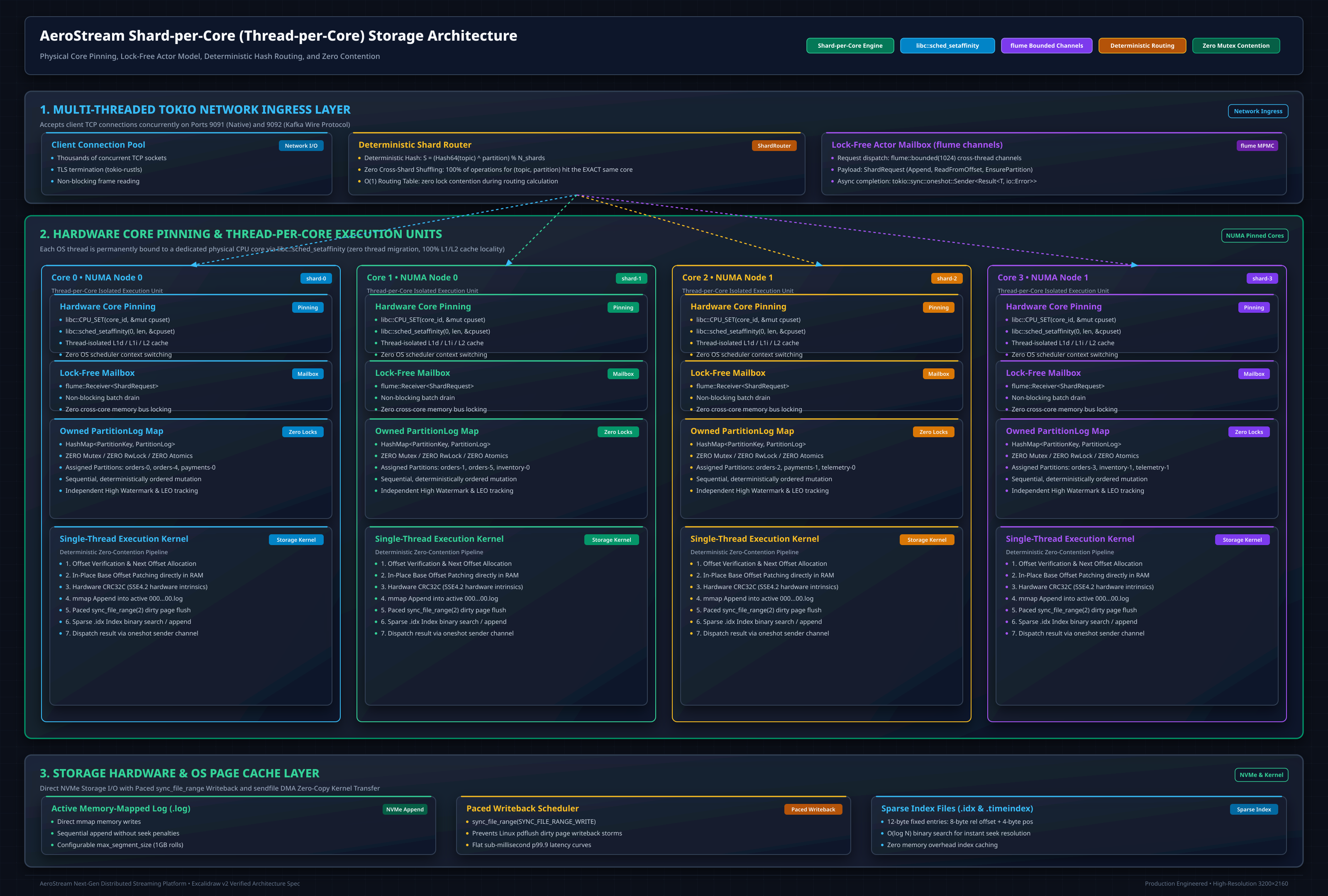
To eliminate cross-thread locking on high-throughput paths, AeroStream adopts a Shard-per-Core model:
-
Deterministic Shard Assignment: Topic partitions are deterministically mapped to dedicated worker threads via the
ShardRouterhash partition mapping function:\[S = \text{hash}(\text{topic}, \text{partition}) \pmod N\]where \(N\) denotes the total number of pinned shard execution threads (\(N = N_{\text{shards}}\)). For a topic name \(T\) and partition index \(p\):
\[S = \left( \mathcal{H}_{\text{64}}(T) \oplus p \right) \pmod N\]This ensures uniform partition spreading across available CPU execution units without global coordinator locks or thread migrations.
-
Thread-to-Core Affinity: Worker threads are pinned to dedicated physical CPU cores using Linux
libc::sched_setaffinity: -
Lock-Free Actor Channels: Ingress network connections dispatch record batches to the designated core worker via
flume::unboundedlock-free ring-buffers—eliminating cross-core mutexes, atomic CAS loops, and CPU cache-line bouncing.
Positioned Writes Without Lock Races
In conventional file I/O, concurrent appends to an open file handle require acquiring a file-pointer lock (lseek + write).
AeroStream completely bypasses file-pointer mutex contention using Linux positioned writes (pwrite(2)):
// Positioned write directly at the calculated segment byte offset
file.write_all_at(record_bytes, current_segment_offset)?;
Because each write supplies its absolute byte position directly:
- Multiple worker threads can append to non-overlapping partition segments concurrently.
- Active segment lengths are tracked purely in-memory via monotonic atomics, eliminating
statx(2)andlseek(2)system call overheads from the hot produce path.
In-Place Base-Offset Patching (\(\mathcal{O}(1)\))
In the Kafka wire protocol, producers submit RecordBatch payloads with base_offset = 0. Traditional proxies decompress batches, iterate over records, adjust offsets, recompress, and recompute checksums, incurring \(\mathcal{O}(B)\) memory copies:
Because Kafka RecordBatch CRC32C covers only bytes 21 through end-of-batch, the 8-byte base_offset at bytes 0..8 is outside the checksum domain. AeroStream patches the offset in \(\mathcal{O}(1)\) time directly on disk:
let base_offset_bytes = next_offset.to_be_bytes();
segment_file.write_all_at(&base_offset_bytes, batch_start_pos)?;
3. Zero-Copy sendfile(2) Pipeline
When consumers request message batches via Port 9092 (Kafka Fetch) or Port 9091 (Native Streaming), AeroStream executes true zero-copy transfers:
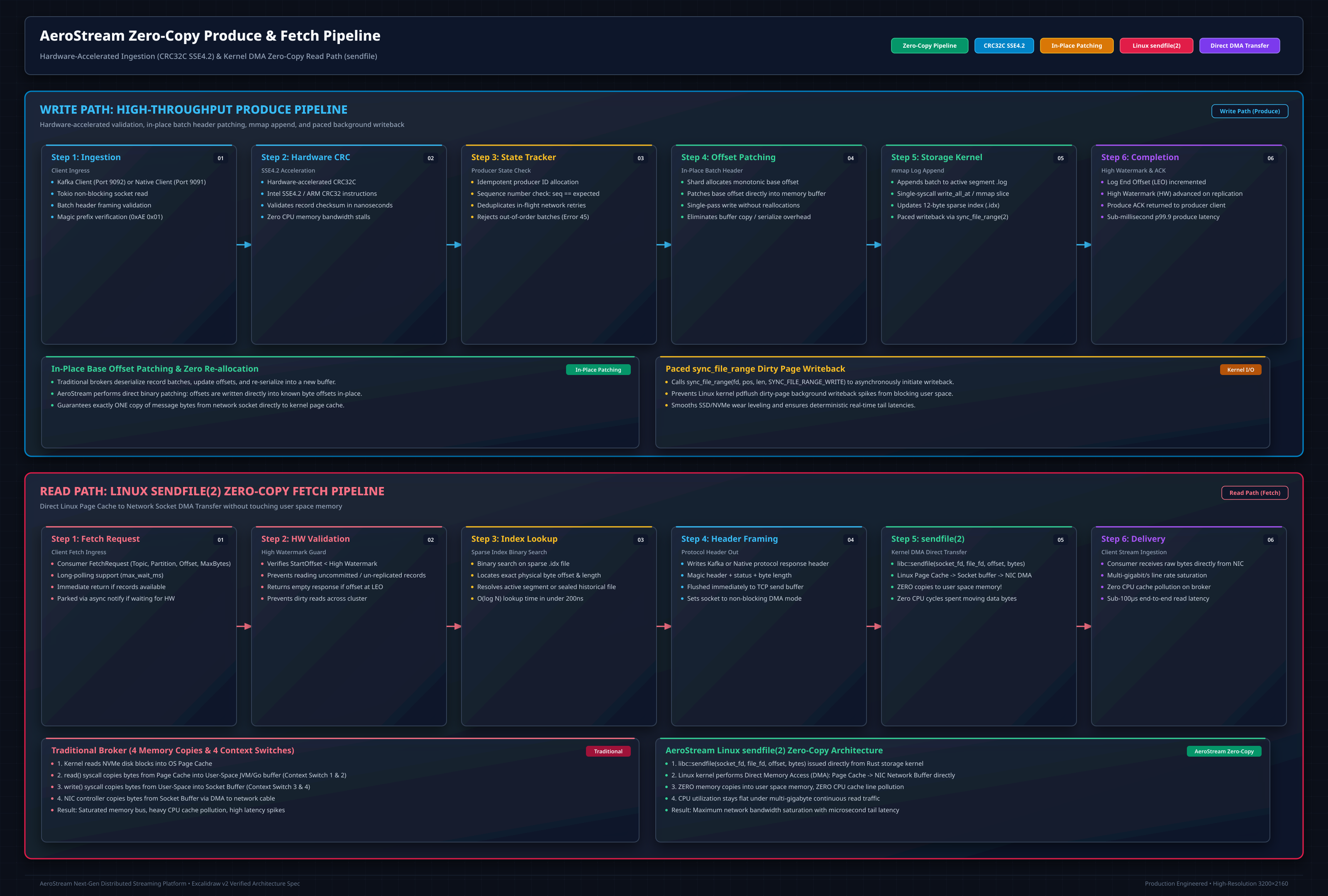
Fetch Path Comparison
| Step | Traditional Monolithic JVM Broker | AeroStream Rust Data Plane |
|---|---|---|
| Read path | Disk \(\to\) Page Cache \(\to\) JVM Heap \(\to\) Socket Buffer | Disk \(\to\) Page Cache \(\to\) Network Socket (sendfile(2)) |
| Userspace copies | 1–2 heap buffer allocations | 0 (kernel zero-copy transfer) |
| CPU Cache footprint | Pollutes L1/L2 data cache with multi-MB payloads | Direct NIC DMA without CPU cache eviction |
| Index search | Java object hierarchy traversal | \(\mathcal{O}(\log N)\) binary search over contiguous .idx mmap |
Memory-Mapped Indexing (.idx)
AeroStream stores sparse index files alongside .log data segments. Each index entry occupies exactly 8 bytes (4 bytes relative offset, 4 bytes physical position).
The broker memory-maps these .idx files using mmap(2). Finding an offset within a 128 MB segment requires \(\mathcal{O}(\log N)\) binary search over a contiguous slice of memory, resolved directly by hardware cache lines.
Paced Page-Cache Writeback
In memory-constrained container environments (e.g., Kubernetes limits of 2 GiB RAM), aggressive OS dirty page accumulation can trigger sudden, seconds-long Linux writeback pauses.
AeroStream protects against writeback pauses by actively pacing kernel writeback, enforcing an upper bound on dirty buffer buildup:
- Every 8 MiB of appended data, the storage engine invokes
sync_file_range(2)withSYNC_FILE_RANGE_WRITE: $\(\text{sync\_file\_range}(fd, \text{offset} - 8\text{MB}, 8\text{MB}, \text{SYNC\_FILE\_RANGE\_WRITE})\)$ - It advises the kernel with
posix_fadvise(POSIX_FADV_DONTNEED)for historical segments, preventing cold consumer reads from evicting hot active ingestion buffers.
4. Hardware CRC32C Acceleration
Every Kafka RecordBatch framing standard mandates a 32-bit Castagnoli polynomial checksum (CRC32C) covering the record batch header and payload.
The Castagnoli generator polynomial is defined as:
Represented in hexadecimal notation as 0x1EDC6F41. For a binary message polynomial \(M(x)\) of length \(k\), the 32-bit CRC checksum \(R(x)\) is computed as the polynomial remainder:
AeroStream leverages specialized CPU hardware instructions:
- x86_64:
CRC32instruction (part of SSE 4.2 / AVX-512) - AArch64 (ARMv8): Hardware CRC extension instructions
#[inline(always)]
pub fn compute_crc32c_hardware(data: &[u8]) -> u32 {
    let mut crc = crc32c::Hasher::new();
    crc.update(data);
    crc.finalize()
}
This hardware pipeline delivers 10.9 GB/s checksum throughput on modern CPUs, removing checksum verification as a bottleneck on 100 Gbps network interfaces:
5. Native Binary Protocol (Port 9091) vs. Kafka Protocol (Port 9092)
AeroStream provides dual listener ingress ports:
- Port 9092 (Kafka Wire Protocol): Drop-in replacement for standard Kafka clients (
kafka-clients,confluent-kafka,kafkajs,franz-go). - Port 9091 (AeroStream Native Protocol): 7-byte ultra-lightweight header framing (
0xAE 0x01), direct memory layout, zero Kafka envelope overhead, designed for sub-millisecond tail latency and maximum hardware efficiency.
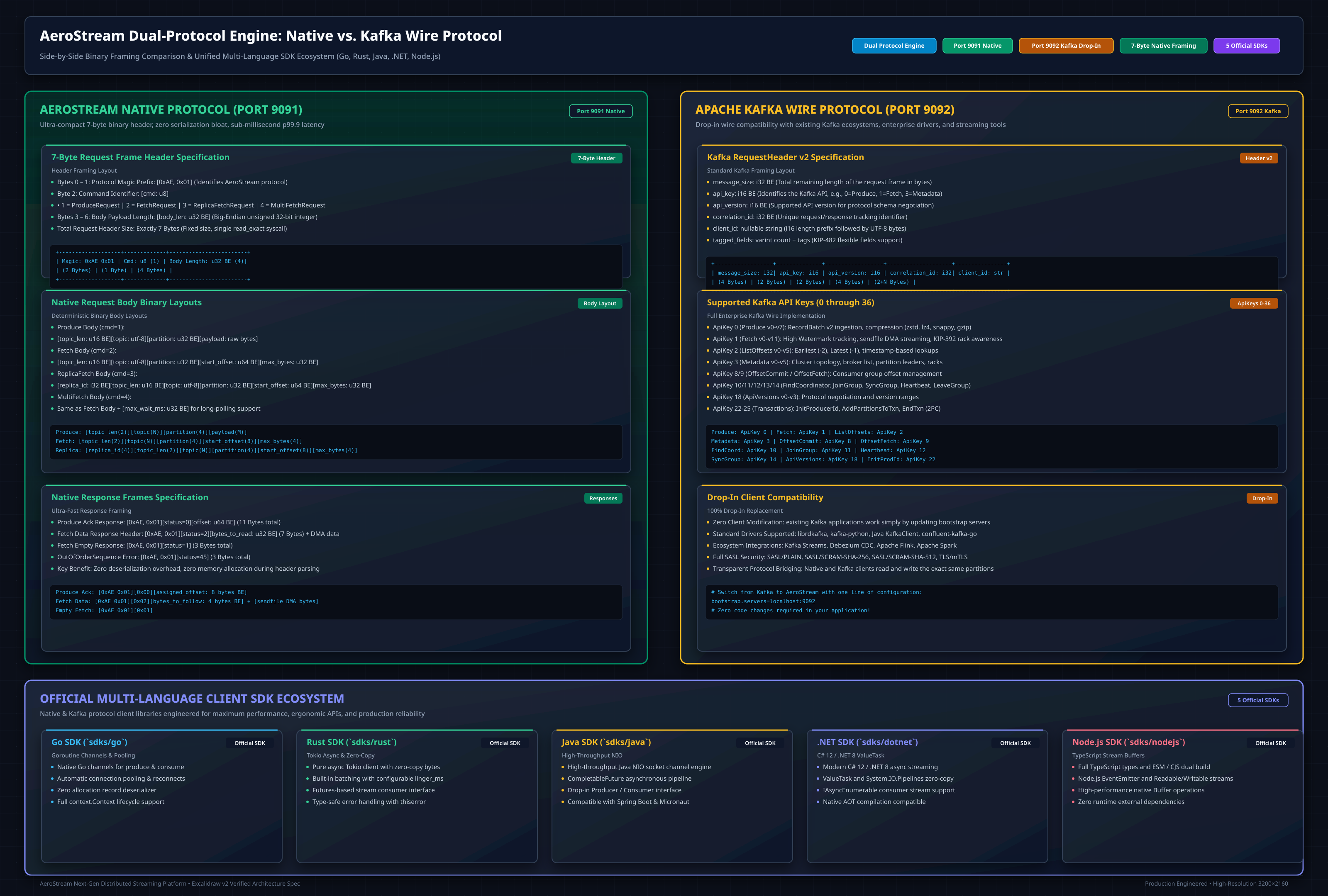
Feature & Efficiency Matrix
| Dimension | Native Binary Protocol (:9091) |
Apache Kafka Protocol (:9092) |
|---|---|---|
| Framing Overhead | 7 bytes total ([0xAE, 0x01, cmd, len]) |
14–48+ bytes (Length, ApiKey, Version, CorrelationID, ClientID, Tags) |
| Parsing Complexity | Fixed-offset slice parsing (\(\mathcal{O}(1)\)) | Varint decoding, tagged fields, flexible headers (\(\mathcal{O}(K)\)) |
| Client Ecosystem | Official aerostream-sdk (Go, Rust, Java, .NET, Node.js) |
Universal Kafka ecosystem (confluent-kafka, librdkafka, spring-kafka) |
| Throughput (1 KB msgs) | 174,714 msg/s (resource-capped container) | 100,000–287,428 msg/s (OMB benchmark on EC2) |
| Median Latency (\(p_{50}\)) | < 0.5 ms | 0.7 – 0.8 ms |
| Tail Latency (\(p_{99}\)) | < 1.0 ms | 1.3 – 1.5 ms |
| Authentication | Command 0 Bearer Token Handshake | ApiKey 17/36 SASL PLAIN / SCRAM-SHA-256 / mTLS |
Native Protocol Command Set
- Command 0 (Auth Handshake): Authenticates client token (
[token: UTF-8]), responding with[0xAE, 0x01, status: u8]. - Command 1 (Produce / Append): Appends payload to topic/partition, returning assigned 64-bit log offset.
- Command 2 (Consumer Fetch): Fetches record bytes bounded by partition High Watermark (\(HW\)).
- Command 3 (Replica Fetch): Inter-broker replication stream advancing replica LEOs.
- Command 4 (Multi-Entry Long-Poll): Multi-record batch fetch with server-side suspension until data arrives or
max_wait_msexpires.
6. Queuing & Saturation Dynamics (Little's Law)
Under heavy load, broker latency follows queuing theory dynamics governed by Little's Law:
where \(L\) is the average number of requests in the system, \(\lambda\) is arrival rate, and \(W\) is mean residence time.
When offered load \(\lambda < \mu\) (where \(\mu \approx 287,428 \text{ msg/s}\) is saturation service capacity):
- Requests process immediately without queuing: \(W \approx \frac{1}{\mu} \approx 0.7 \text{ ms}\).
- Tail latency remains flat (\(p_{99} \le 1.5 \text{ ms}\) at 200,000 msg/s).
When offered load approaches or exceeds service capacity (\(\lambda \to \mu\)):
Requests queue in network and channel buffers, causing latency to elevate while throughput remains pinned at physical saturation capacity (287,428 msg/s, 280.7 MB/s on an 8-vCPU instance, with queueing tail \(p_{99}\) at 149 ms).
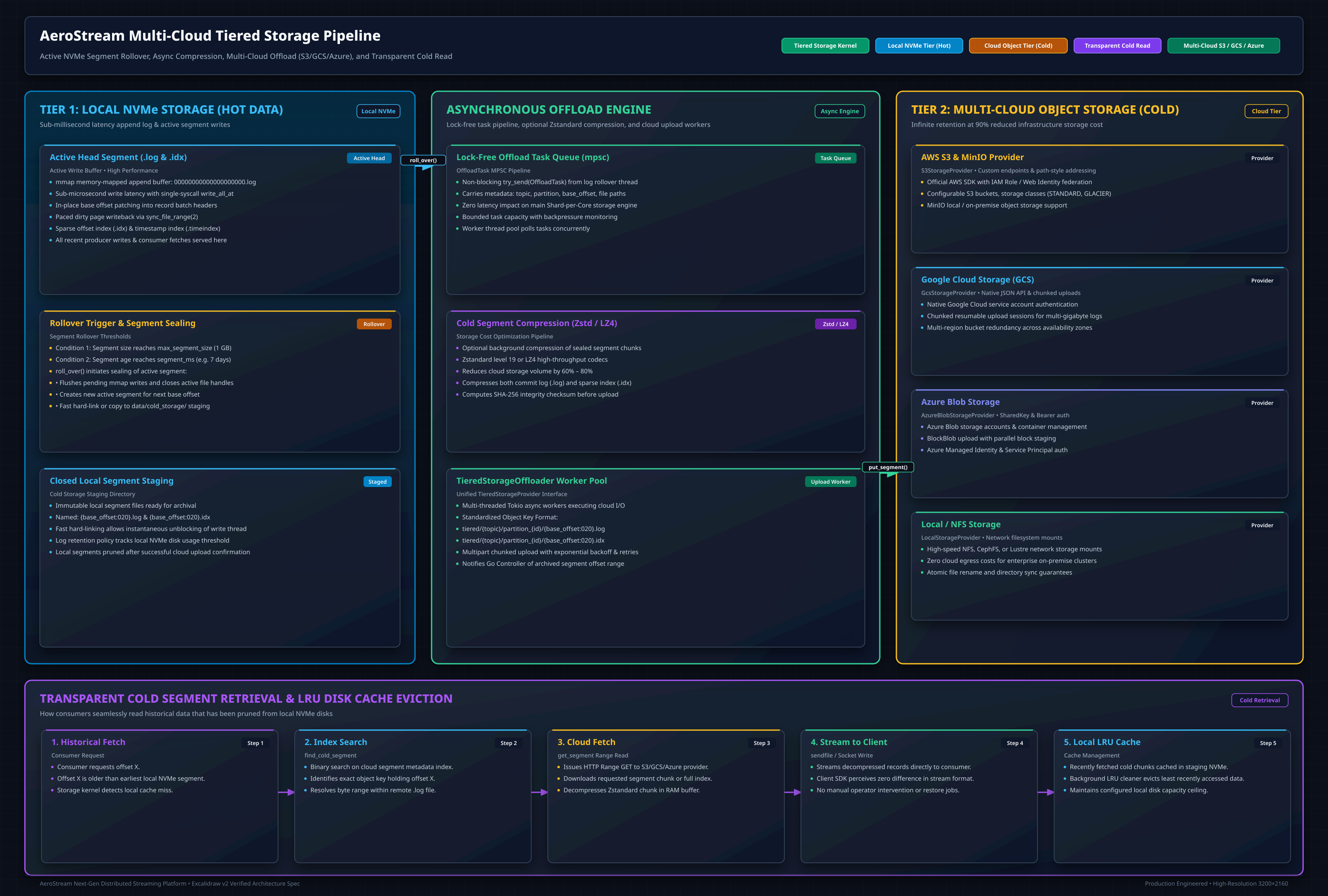
7. Multi-Cloud Tiered Storage & Zero-Downtime Draining
AeroStream completes its architecture with two enterprise production features:
Multi-Cloud Tiered Storage Pipeline
Sealed 128 MB log segments are asynchronously offloaded to cloud object storage (AWS S3, MinIO, Google Cloud Storage, Azure Blob Storage) via zero-copy hard links (fs::hard_link), decoupling long-term data retention from expensive local NVMe capacity.
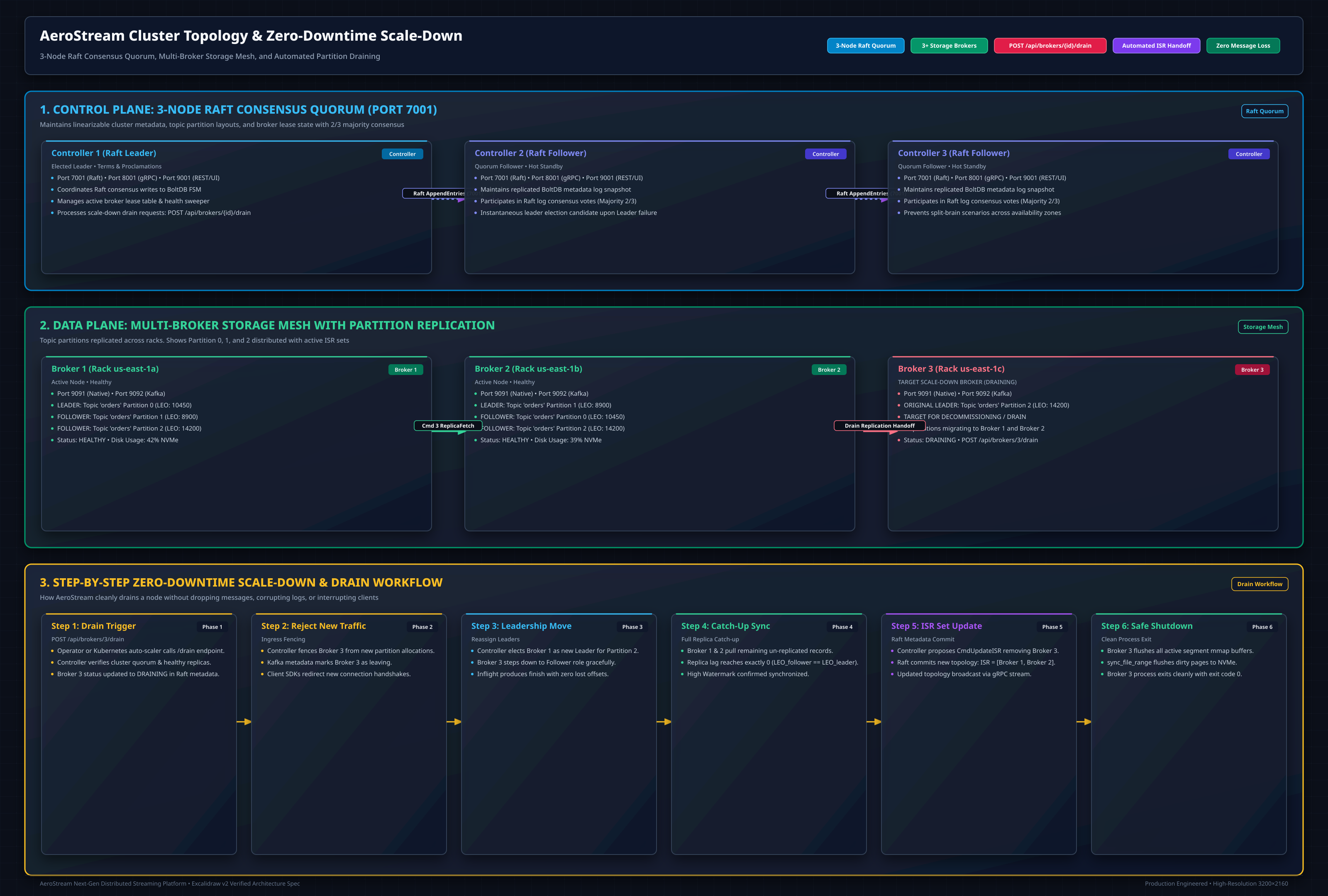
Graceful Cluster Draining
During rolling node maintenance or scale-down events, operators trigger partition draining via POST /api/brokers/{id}/drain. The Go Controller automatically migrates partition leadership to surviving ISR members with zero message loss and zero downtime.